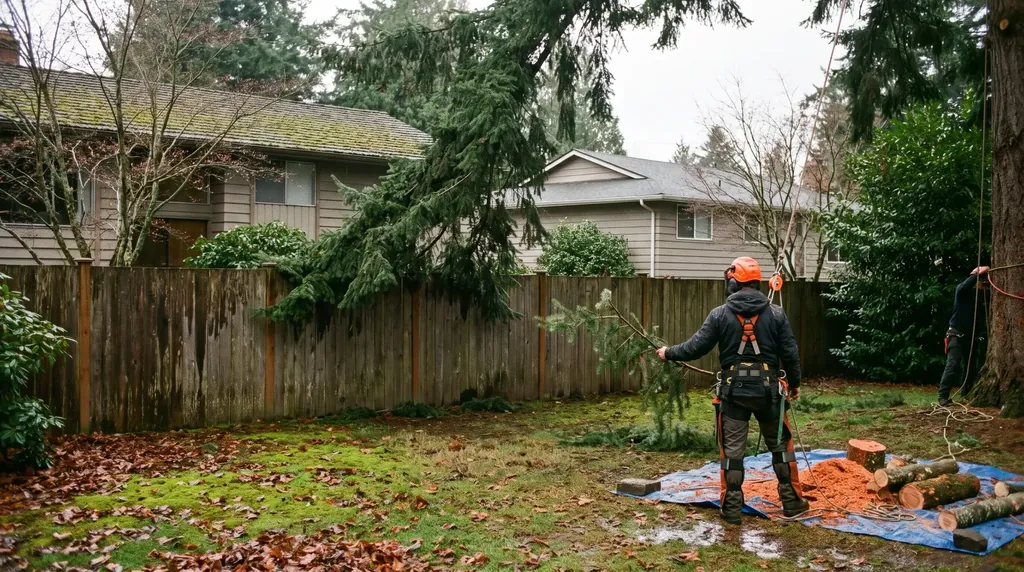
Who Is Responsible for Overhanging Tree Branches in Washington?
- Free on-site estimates
- Sectional takedowns where there is no room to drop
- Full cleanup, or the wood left where you want it
- Storm calls taken outside regular hours
In Washington, the tree belongs to whoever owns the land the trunk grows on, and keeping it in safe shape is generally their job. If branches hang over onto your side, you can usually trim them back to the property line yourself, at your own cost, as long as you do not go onto your neighbour’s land and do not kill or seriously damage the tree. That is the short version. The longer version matters when the tree is big, the branches are over a roof, or the tree comes down in a storm.
General information, not legal advice. Neighbour tree disputes turn on the facts. If one is getting serious, talk to a Washington attorney.
Who is responsible for cutting overhanging tree branches in Washington state?
Two things are true at once. The owner is responsible for the tree, and you have a general right to deal with what crosses onto your side. In practice that means you do not need your neighbour’s permission to trim back limbs over your yard, but your neighbour is not usually obliged to pay for it either, unless the tree is dead or dangerous and they knew it.
We are confirming how current Washington law treats trimming over the line and an owner’s duty for a dangerous tree before publishing specifics. Until then, treat the general rule above as a starting point, not a final answer.
Can I just cut branches off a tree?
Off your neighbour’s tree, on your side, generally yes, with limits. Cut at the line or back to a sensible point on your side, never from a ladder leaned against their tree, and never by climbing into it without asking. The bigger limit is that you cannot trim so hard that the tree dies or falls, and if it does come down after a heavy cut, the conversation changes.
Good cuts matter too. Cut just outside the branch collar, the slight swelling where the limb meets the trunk, rather than flush or leaving a long stub. Big limbs need to come off in stages so the weight does not tear bark down the trunk.
How many branches can you cut off a tree without killing it?
Less than most people think. A healthy tree can usually handle losing no more than about a quarter of its live crown in one season, and less for big mature conifers and stressed trees. Topping a fir or cedar, cutting the top out to shorten it, does not make it safer. The new tops that grow back are weakly attached and tend to break off later.
If the goal is getting branches off a roof or out of a view, thinning and reduction cuts spread over a couple of seasons work better than one heavy cut.
Can I throw neighbor’s tree branches back in their yard?
Do not. Once you have trimmed branches on your side, the clean-up is generally yours. Dumping them over the fence turns a tree question into a property damage and nuisance question, and it rarely ends well. Chip them, take them to a yard waste facility, use your yard waste cart, or arrange with your neighbour to share the cost of a crew doing both sides at once.
Who is liable if a tree falls down?
When a healthy tree comes down in a windstorm, it is usually treated as an act of nature, and each homeowner’s own policy tends to handle damage to their own property. The picture changes when the tree was visibly dead, rotten, cracked or leaning and the owner had reason to know. Then the owner may be held responsible for what it hits.
We are confirming how Washington law and typical homeowners policies treat neighbour tree damage before publishing specifics. Call your insurer before work starts on any fallen tree and take photos first.
If you are worried about a neighbour’s tree, the most useful thing you can do is tell them in writing, with a photo, and suggest an assessment. That protects everyone.
Can a neighbour cut my tree without permission?
Trim the overhang on their side, generally yes. Cut the tree down, top it, or cut so hard it dies, no. Washington has a timber trespass law that can make cutting or damaging someone else’s tree very expensive, and that includes cutting on the wrong side of an unclear boundary.
We are confirming the current state rules on damages for cutting someone else’s tree before publishing specifics. If a tree sits on or near the line, get the boundary confirmed before anyone cuts.
Neighbour tree questions
Can I get my neighbour to cut back or reduce the height of their trees?
You can ask, and most people agree when it is raised early and reasonably. Unless an HOA covenant or view agreement says otherwise, or the tree is genuinely dangerous, a neighbour is not usually required to cut a healthy tree down to size.
Do I have to pay a deductible if my neighbor's tree fell into our yard then damage your car?
Often your own policy handles damage to your own property and your deductible applies, unless the neighbour was negligent about a tree they knew was dangerous. Every policy is different, so ask your insurer before assuming either way.
Will insurance pay for tree removal?
Often when a tree falls on a covered structure, and often not for removing a standing tree, whether it is healthy or dead. Check your own policy before work starts.
Branches over the line? Let us take a look.
Send a photo of the tree, the branches and what they are over. We will tell you what can be trimmed, what should stay, and whether the tree is sound.
- Call(360) 555-0119
- Emailoffice@bellinghamtreeremovalpros.com
- HoursMon to Sat, 7am to 6pm. Storm damage calls taken outside those hours.
Thanks, we have your request
We will call or text to set a time to look at the tree. If it is urgent, call (360) 555-0119.
Online requests are not switched on yet
Nothing was sent. Please call (360) 555-0119 and we will set up a time to look at the tree.